
Coastal section: Seven Sisters
Sussex RIGS number: TV59/10b
Forms part of the Seaford to Beachy Head SSSI designated for its geological and biodiversity value (Site Code 1000182)
The LGS site is located within Unit 2 of the SSSI.
Forms part of the Beachy Head to Seaford Head Geological Conservation Review (GCR) Site
Block: Coastal Geomorphology of England (Site Code 1850)
Seven Sisters LGS is within the Seven Sisters Country Park, managed by East Sussex County Council
Seven Sisters LGS is in the South Downs National Park
Grid Reference: TV520976 to TV550962


Site access:
Seven Sisters LGS is located in the Seven Sisters Country Park.
This 3km stretch of beach is only accessible from either end and extreme care should be observed with tides. At its western end the Seven Sisters foreshore is accessible by public footpaths from Exceat, about 2 km. There are two pay and display car parks at Exceat. At its eastern end the Seven Sisters foreshore is accessible from Birling Gap where the National Trust provides car parking and a cafe.
The cliff top between Cuckmere Haven and Birling Gap is accessible by the South Downs Way.
Summary Description:
21/07 and 27/07/2011
(from East Sussex RIGS Survey 2011)
Interest Feature(s)
Bedrock:
3 km of undefended chalk cliffs up to 80 m in height (at Haven Brow) cutting across seven dry valleys of varying size. The cliffs expose mainly Seaford Chalk with basal Newhaven Chalk present in the upper cliffs between the dry valleys. The extensive wavecut platform exposes Seaford Chalk.
Stratigraphy: Seaford Chalk, Newhaven Chalk Formations, White Chalk Subgroup, Upper Cretaceous (Coniacian-Santonian) in age.
Sedimentology: The Seaford and Newhaven Chalks are relatively uniform in texture and include marl seams. Within both formations are numerous layers of sheet or nodular flints. An orange-stained sponge bed and hardgrounds are present in the Seaford Chalk. Deposited in a relatively deep marine environment.
Sedimentary structures: The bedding is well-defined by flint bands and marl seams. The Seven Sisters flint band and the Belle Tout marls are prominent markers close to the base of the cliffs.
Structural geology: Bedding dips very gently east towards the axis of the Birling Gap syncline. The joint sets are typically regular and nearly vertical, and these control the shape of the cliffs.
Palaeontology: Fossils are commonly found in the chalk and can be obtained from the base of the cliffs and from fallen blocks. They include echinoids, inoceramids, crinoids, polyzoa and fossils from the Cuckmere Sponge Bed.
Superficial deposits:
Head deposits of Pleistocene age occur in some of the dry valleys and are seen in cross-section at the top of the cliffs. Thin loessic deposits are more widespread.
Stratigraphy: Pleistocene, probably Devensian or Loch Lomond Stadial in age, and Holocene.
Sedimentology: Flinty gravels and coombe rock, overlain by thin loess deposits.
Sedimentary structures: Under the dry valley deposits is a zone of deeply weathered chalk with broken chalk and distorted flint layers. Cryoturbation lobes occur at the top of the chalk away from the valley bottoms.
Geomorphology:
This is a classic site for chalk dry valleys
Site map - Survey visits 21/07 and 27/07/2011
Site access:
Seven Sisters LGS is located in the Seven Sisters Country Park.
This 3km stretch of beach is only accessible from either end and extreme care should be observed with tides. At its western end the Seven Sisters foreshore is accessible by public footpaths from Exceat, about 2 km. There are two pay and display car parks at Exceat. At its eastern end the Seven Sisters foreshore is accessible from Birling Gap where the National Trust provides car parking and a cafe.
The cliff top between Cuckmere Haven and Birling Gap is accessible by the South Downs Way.
RIGS Designation Criteria:
Scientific Details and Site Description
This coastal section covers the Seven Sisters from (but not including) Cuckmere Haven to Birling Gap.
Stratigraphy: The Seven Sisters cliffs are composed of the Seaford and Newhaven chalk members of the Upper Chalk of the Cretaceous.
Sedimentology: The sediments consist of chalk, with several key flint bands (Seven sisters, Bedwell's Columnar), marl seams (Belle Tout Marl), hardgrounds and orange-stained spongebeds.
Sedimentary structures: The near-horizontal beds are picked out in places by flint bands. A major band near the base of the cliffs is the Seven Sisters Flint Band.
Structural Geology: The joint sets are typically regular and nearly vertical, and these control the shape of the cliffs.
Palaeontology: Fossils are commonly found in the chalk and include echinoids eg Micraster coranguinum and related species. The Inoceramids Platyceramus and Volviceramus are found in situ at the base of the cliff and Cladoceramus are obtained from fallen blocks. Crinoids such as Uintacrinus socialis can also be found fallen from above. Polyzoa and other fossils are common. Towards the eastern end of the Seven Sisters, opalised wood and aptychi are obtainable from fallen blocks of an inaccessible Cuckmere sponge bed.
Geomorphology: The site is a classic one for its dry valleys with great tourist appeal.
Biological interest: The clifftop flora is both interesting and important and the area forms part of the Seven Sisters Country Park and is used extensively for recreation and walking.
Educational value: These cliffs are of great value for scientific studies of chalk stratigraphy, environmental conditions, sedimentation and palaeontological studies. The site is easily accessible although care should be taken regarding potential cliff falls and tidal conditions. The area is of interest to geologists, and is suitable for large groups. The cliff fauna and flora are of interest to natural historians and the whole area is used for recreation and walking.
Seaford to Beachy Head SSSI
Reasons for Notification - extracts:
Seaford to Beachy Head is an outstanding site of national importance for its biological and geological features. The diverse range of habitats includes herb-rich chalk grassland, chalk heath (a unique, rare habitat on chalk soils), maritime grassland, foreshore and chalk cliffs, river meanders, and Greensand reef. Together, these habitats support a number of nationally rare, nationally scarce and nationally significant plants, invertebrates and birds.
The cliffs and chalk platform beneath are identified in the Geological Conservation Review as outstanding for their geological and geomorphological interest.
The site lies at the eastern end of the South Downs which terminate in the chalk cliffs of the Seven Sisters. The majority of the site, therefore, lies on chalk but the River Cuckmere breaches the cliffs to form a broad alluvial valley. There is also a distinct coastal zone which includes all of the geological interest.
Geology
The site is important for earth science interests, particularly for its chalk stratigraphy, periglacial geomorphology and the study of chalk landscape evolution.
Seaford -Beachy Head is a key site for coastal geomorphology, comprising a cliff beach- shore platform system developed on chalk. The site includes the classic coastal cliffs of Beachy Head and the Seven Sisters. In contrast with the cliffs at Foreness Point (Kent) and Kingsdown - Dover (Kent) where structural controls prevail, the plan of the Seaford - Beachy Head coastline is controlled primarily by wave energy; with the dominant and prevailing wave energy from the southwest.
The beach is one of six major south west facing beaches in southern England and all of the others differ significantly in geological characteristics. In addition the beach is the most rapidly and consistently fed by flint from cliff falls.
GCR Site Account:
Beachy Head to Seaford Head
Introduction
Block: Coastal Geomorphology of England (Site Code 1850)
The Chalk of the South Downs reaches the sea between Brighton and Eastbourne in a series of cliffs that become generally higher towards the east and culminate in the 150 m-high cliffs of Beachy Head. This site comprises a cliff-beach-platform system developed on the Chalk, includes the classic world-renowned cliffs of Beachy Head and the Seven Sisters, and cuts across the mouth of the Cuckmere Valley. The cliffs reach a maximum height of 156 m at Beachy Head (TV588956) and vary between 14 m and 79 m in height along the Seven Sisters. Retreat of the cliffs has been estimated at 0.42 m a-1, reaching a maximum of 0.91 m a-1 at Birling Gap (May, 1971a). A narrow fringing beach of chalk and flint rests upon the cliff-platform junction, except where major falls, especially at Beachy Head, extend below low-tide level. Debris ramparts from cliff-falls are common at Beachy Head. The coastline plan is controlled primarily by dominant and prevailing wave energy from the south-west, with Seaford Head and Beachy Head acting as more resistant points between which a predominantly wave-energy controlled shoreline has developed. Structural variations seem to have had little effect upon the overall coastal plan, the cliff materials being sufficiently rapidly eroded to ensure control by wave action. However, in detail the cliffs are controlled by a rectilinear jointing pattern. The beach is one of six major SW-facing beaches in southern England, all of which differ significantly in their geological characteristics. Most of the site faces south-west and is exposed to Atlantic waves. The fetch from the south-west is similar to that which affects all the major beaches in the English Channel. The cliff and beach of Seven Sisters in particular is unusual in having a very strong similarity in its alignment to such beaches as Chesil Beach and Dungeness. Of the beaches, Seven Sisters beach is the most rapidly and consistently fed by flint from cliff-falls. The most directly comparable cliffs also comprise Upper Chalk along the Normandy coast, but they lack the same aspect and degree of exposure.
The LGS site represents the western part of sub-unit 3 of the GCR: The truncated dry valley mouths, cliffs and platforms of the Seven Sisters, including Birling Gap (TV579953 to TV521976).
The full site account is on the JNCC website.
Published in the Geological Conservation Review
Volume 28: Coastal geomorphology of Great Britain (2003)
Chapter 4: Soft-rock cliffs
East Sussex Local Geological Sites - Coastal Section Seven Sisters
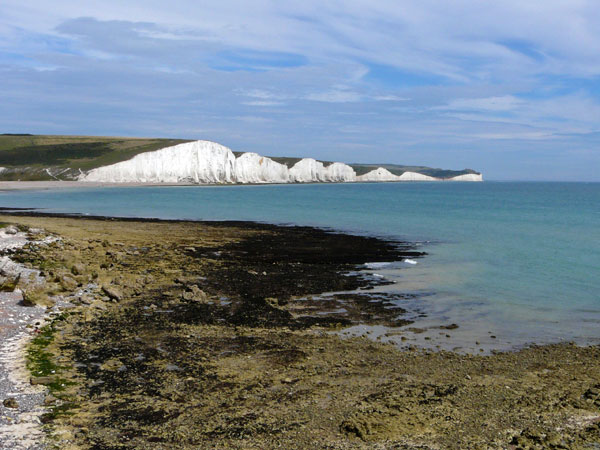
Seven Sisters cliffs viewed from Hope Gap steps. From this point seven cliffs are evident with intervening truncated dry valleys. However the view is foreshortened and the named Seven Sisters actually lie between Cuckmere Haven at left and Birling Gap, the large dry valley at the east (right) end.
Photograph taken: 25/07/2011
Grid ref TV50969737
Direction ESE
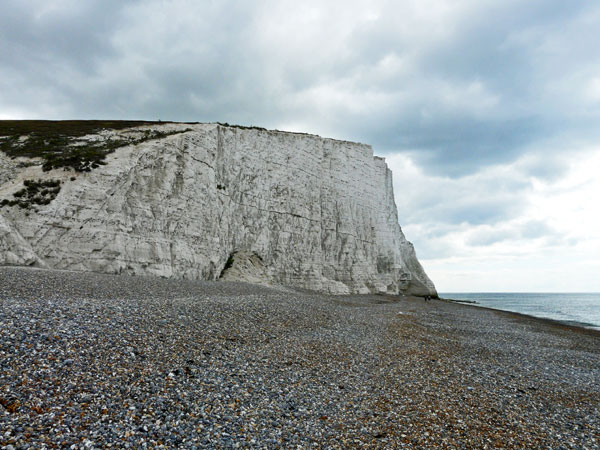
Western end of cliffs at Cuckmere Haven. Up to 80 m high exposing mainly Seaford Chalk. Beds here dip to the east and the Seven Sisters flint band rises up the cliff face.
Photograph taken: 27/07/2011
Grid ref TV52089754
Direction SE
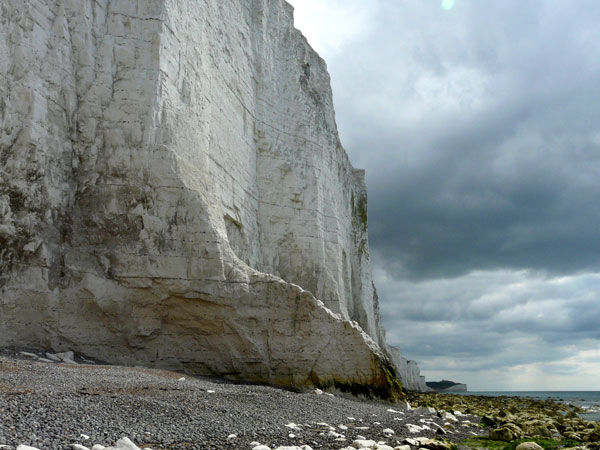
Part of a succession of buttresses at the base of the western cliffs beneath Haven Brow. Mainly Seaford Chalk exposed with Seven Sisters flint band crossing the middle of the buttress.
Photograph taken: 27/07/2011
Grid ref TV52319738
Direction ESE
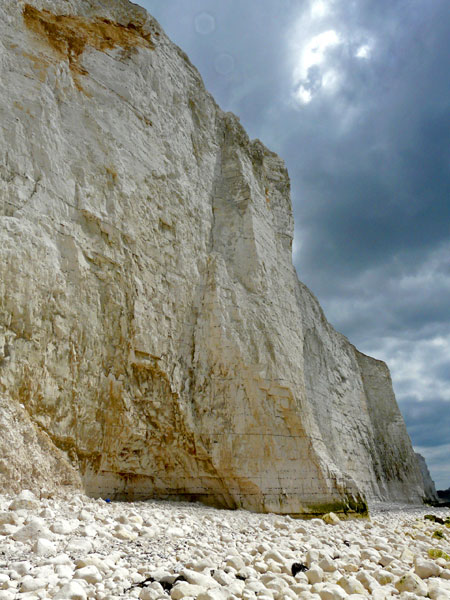
Vertical face of Seaford Chalk about 70 m high beneath Short Brow. Foreshore covered with relatively fresh reworked debris from rockfalls.
Photograph taken: 27/07/2011
Grid ref TV52709724
Direction ESE
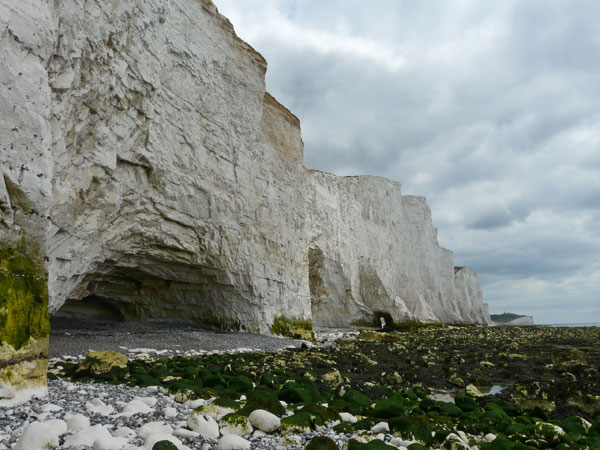
Cliffs below Limekiln Bottom dry valley looking towards Rough Brow. Large sea cave in foreground and buttress with arch beyond. Foreshore strewn with seaweed-covered boulders.
Photograph taken: 27/07/2011
Grid ref TV52839716
Direction ESE
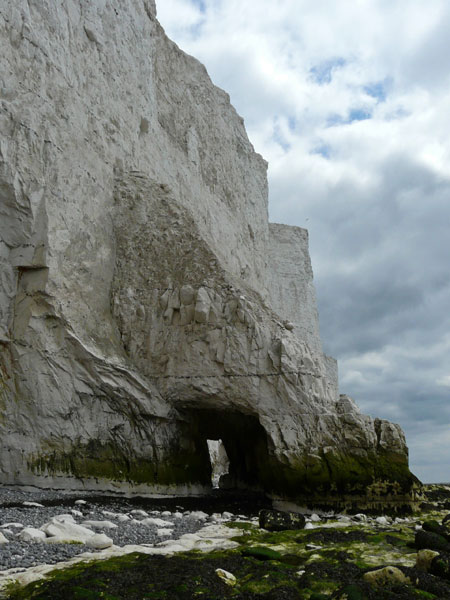
Vertical cliffs beneath Rough Brow with large buttress and arch at base.
Photograph taken: 27/07/2011
Grid ref TV52929714
Direction ESE
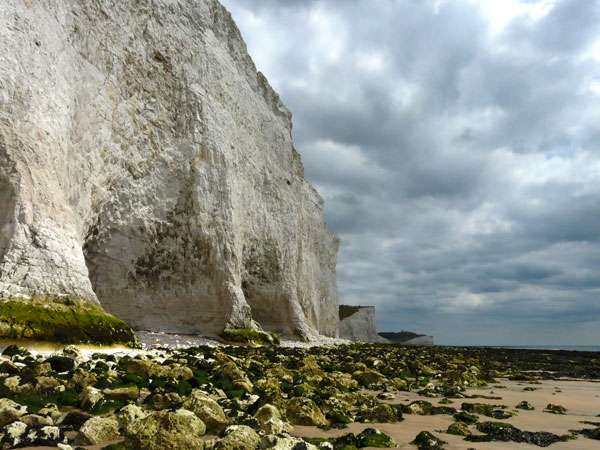
Vertical cliffs of Seaford Chalk about 65 m high at Brass Point showing large rounded sea caves and buttresses.
Photograph taken: 27/07/2011
Grid ref TV53269696
Direction ESE
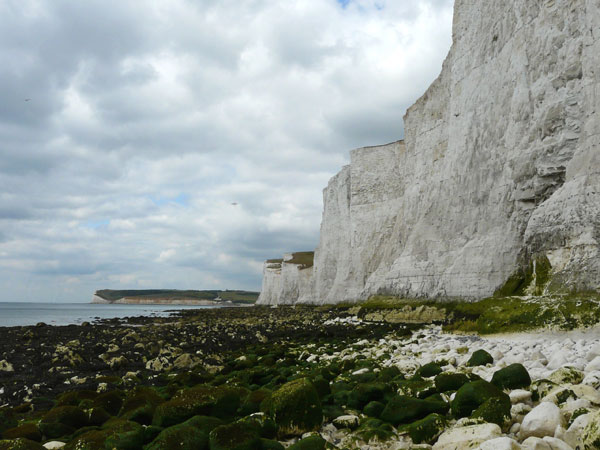
View from below Brass Point along western part of the Seven Sisters cliffs towards Hope Gap.
Photograph taken: 27/07/2011
Grid ref TV53379694
Direction WNW
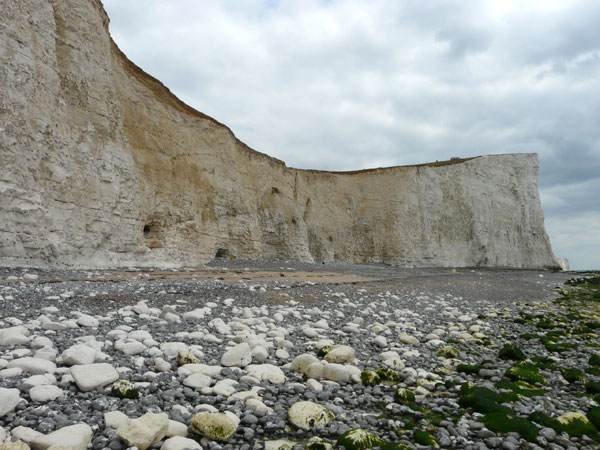
Dry valley at Gap Bottom showing thin head deposits overlie deeply weathered brownish chalk with distorted remnants of flint bands. Flint bands at base of cliff are relatively undisturbed.
Photograph taken: 27/07/2011
Grid ref TV53649685
Direction east
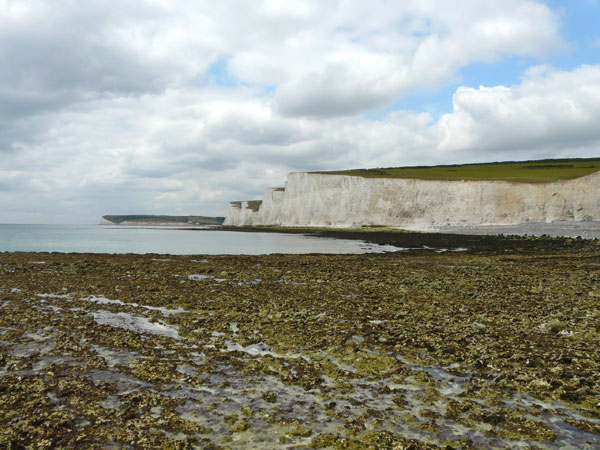
Cliffs to the west towards Hope Gap viewed from well-exposed wavecut platform at Flagstaff Point. The dry valley at right is Gap Bottom.
Photograph taken: 27/07/2011
Grid ref TV53819665
Direction NW
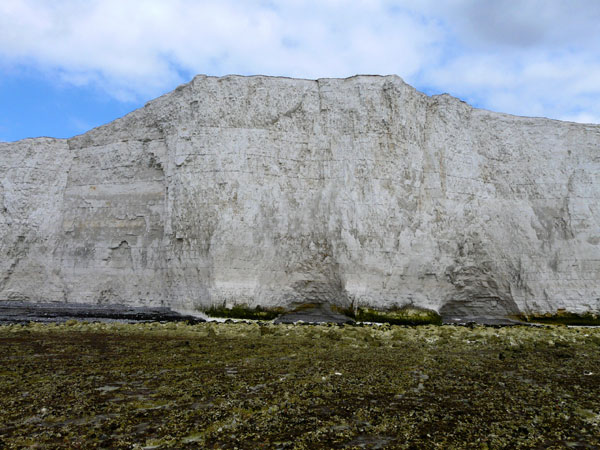
Cliffs at Flagstaff Point about 50 m high exposing horizontally bedded Seaford Chalk with numerous flint bands. Two rounded sea caves at base.
Photograph taken: 27/07/2011
Grid ref TV53819665
Direction NE
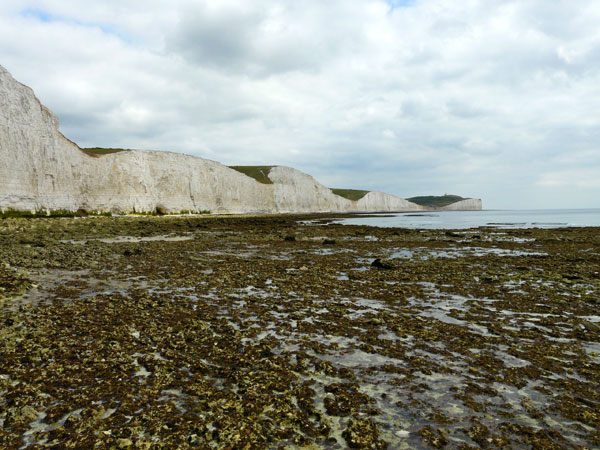
Cliffs to the east viewed from well-exposed wavecut platform at Flagstaff Point. The truncated dry valleys are Flagstaff Bottom, Flathill Bottom and Michel Dean with Birling Gap at far right.
Photograph taken: 27/07/2011
Grid ref TV53819665
Direction east
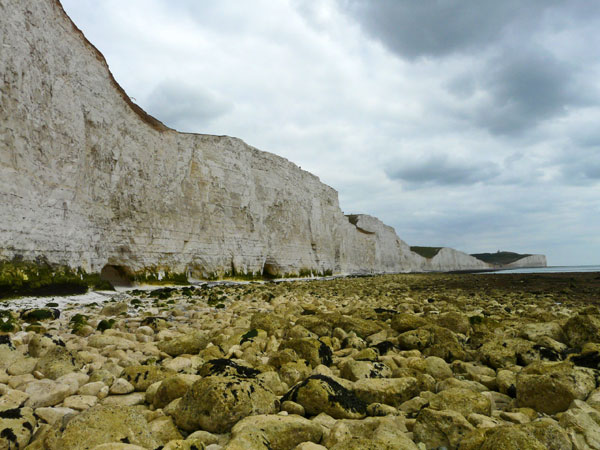
Cliffs east of Flagstaff Point about 50 m high exposing horizontally bedded Seaford Chalk with numerous flint bands. Thin dry valley Pleistocene deposits at top of cliffs (Flagstaff Bottom) and sea caves at base.
Photograph taken: 27/07/2011
Grid ref TV53949671
Direction ESE
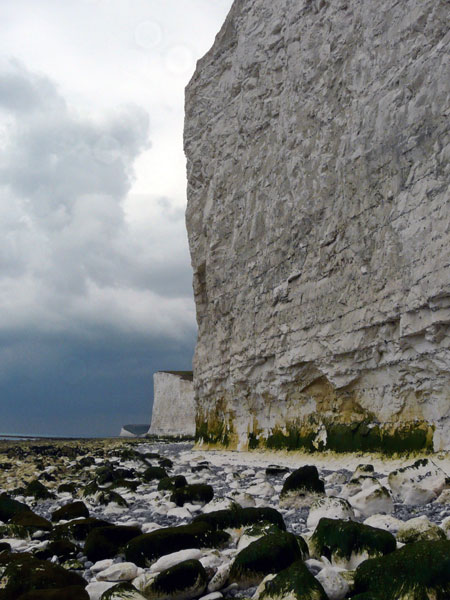
Vertical cliffs about 40 m high in Seaford Chalk beneath Flat Hill showing closely spaced flint bands.
Photograph taken: 21/07/2011
Grid ref TV54379660
Direction WNW
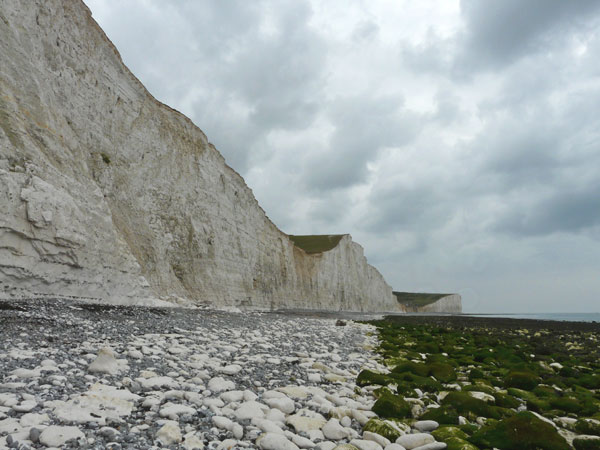
Cliffs east of Baily's Hill exposing Seaford Chalk with numerous flint bands. The nearer dry valley is Michel Dean and the far one is Birling Gap.
Photograph taken: 21/07/2011
Grid ref TV54629648
Direction ESE
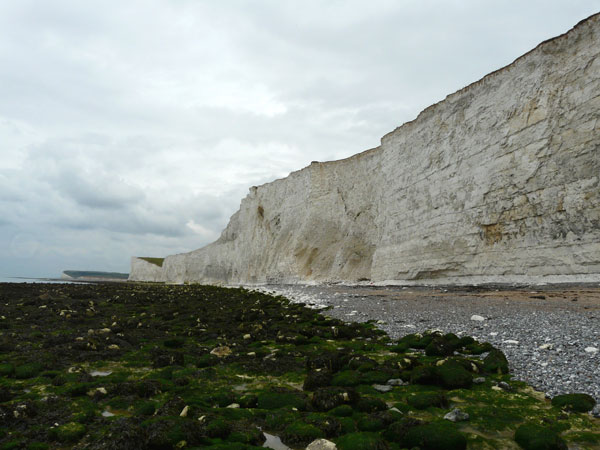
Cliffs up to 60 m high beneath Baily’s Hill. Thin Pleistocene loessic deposits overlie Seaford Chalk. Rockfall debris at foot of highest cliffs.
Photograph taken: 21/07/2011
Grid ref TV54769641
Direction WNW
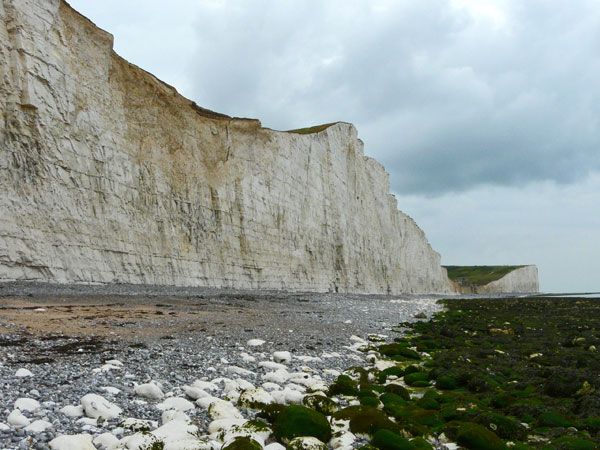
Cliffs from Michel Dean dry valley east to Birling Gap. Dry valley Pleistocene deposits and weathering clearly visible.
Photograph taken: 21/07/2011
Grid ref TV54719644
Direction east
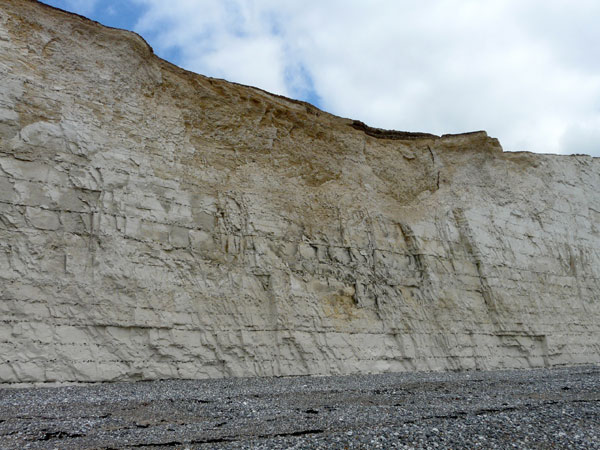
Cliffs about 30 m high at Michel Dean dry valley. Thin head deposits overlie deeply weathered brownish chalk with distorted remnants of flint bands. Clear transition to unweathered chalk below.
Photograph taken: 27/07/2011
Grid ref TV54749641
Direction NE
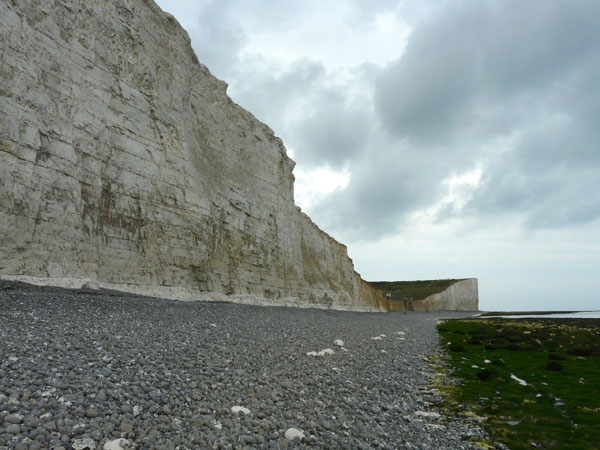
Cliffs up to 40 m high beneath Went Hill Brow looking east to Birling Gap dry valley and the Belle Tout headland.
Photograph taken: 21/07/2011
Grid ref TV55079622
Direction SE
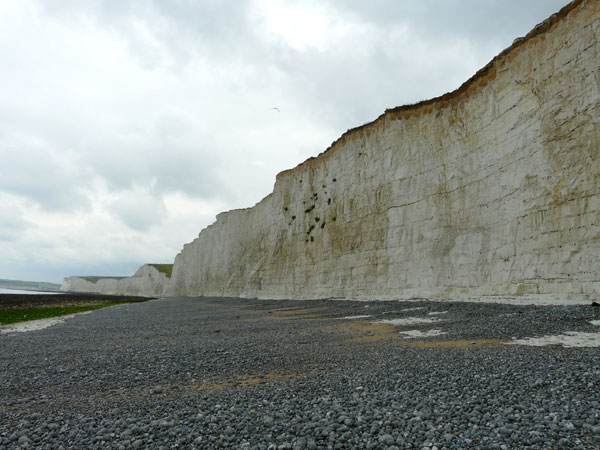
Cliffs west of Birling Gap about 30 m high exposing Seaford Chalk. Thin Pleistocene loessic deposits at top of cliff with cryoturbation lobes at top chalk.
Photograph taken: 21/07/2011
Grid ref TV55279607
Direction WNW
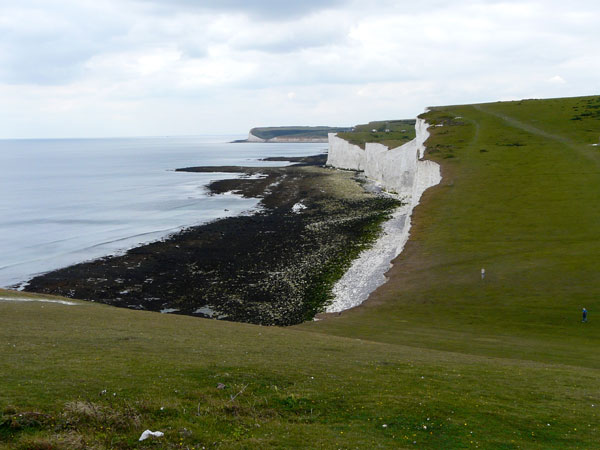
Looking across Michel Dean dry valley and exposed wavecut chalk platform out to Flagstaff Point.
Photograph taken: 27/07/2011
Grid ref TV54899638
Direction WNW